
By Grant J. Riley
As crisp and bright memories of birthday weekends with the Seedy Sistas in summery Sussex fields fade with the yellowing leaves, the arrival of autumn brings me back home to Vietnam and the onset of cyclone season.
I’m from the UK but have lived in North Vietnam for just over a decade, where plant life is central to nearly everything. I write entirely—and unapologetically—from the anecdotal, as much as I have managed to read and glean from this vast country, home to 130 million people, including 54 ethnic minorities. As an Englishman, I can only really share my personal observations and experiences.
Living on the Red River Delta
 We now live out on the Red River Delta, between the port of Hai Phong and the capital, Hanoi. The Mekong Delta is probably better known but lies far to the south of this long, narrow country. Our village is central to the lychee trade, and evidence of this once-lucrative fruit remains: aged brick walls topped with broken glass to deter scrumping thieves, small concrete huts for watching over the crops, and grandma’s tales of when one tree’s harvest was worth a gold coin. Alas, there are no longer gold coins, and this year, with a bumper harvest, the price dropped to about 10,000 Vietnam Dong (around 30p a kilo). However, the lychee harvest was mighty, their chilled sweetness a delight, and a serious addiction developed to our delicious homemade sorbet.
Amidst the lychee orchards, there is plenty of subsistence, self-sustaining farming going on. Food is growing everywhere. When my Vietnamese wife accompanied me to the UK, she simply couldn’t understand the ‘lawn’—understandably so. No patch of land appears to go to waste here; even narrow strips next to footpaths are filled with herbs or small crops like spring onions.
Another anecdote is when I grew an avocado from seed in Hanoi—they shoot up here with a twelve-month growing season. After a few years, it was over six feet tall, so we planted it on our land in the village. It quickly doubled in size, but it bore no fruit—this is not the right territory – no other trees to cross-pollinate with. My brother-in-law chopped it down while I was away one day. A bit brutal, but equally pragmatic. There is not one tree, plant, or person here not doing something—that’s how it is; a great metaphor, I conceded. 
Food and Medicine
In the village, there are bananas, mangoes, pomelos, longans, and, of course, lychees, among many others. The only non-fruiting trees are the spiritual ones—the mighty Bodhi—Buddha’s tree.
Our local, thousand-year-old Dong Ngo Pagoda features an over 700-year-old plumeria (frangipani) tree. This flower is considered sacred in many parts of Asia, particularly in Hinduism and Buddhism, where it is used in religious ceremonies and symbolizes immortality, purity, and spirituality. Often found in temples and graveyards, it is offered to the gods, reflecting its deep connection to the divine and the cycle of life and death.
You quickly learn here that plant food and medicine are one and the same. As I ate my first Viet meals and absorbed as much cultural knowledge as possible, my mentors would point to a leaf in the noodle soup—‘this one is for your lungs, these bitters for your liver.’
 All food is served communally, just as everyone in society is referred to by family names—older sister, auntie, grandma… Anh Com! (Come eat). If you fall ill, don’t expect an aspirin; instead, prepare for stacked portable pots of porridge, perhaps with pig’s heart and some mystery leaves. Yep, here, food is medicine.
We live among the Viet Kinh, the majority ethnic group in Vietnam, who make up about 87% of the population. However, especially around the edges—in the mountains, borderlands, and no-man’s lands—there are 54 ethnic minority groups, the hill tribes of old. These groups are not indigenous to the region but are migrants over time. In the North, many, particularly the H’mong and Dao, originated from China. Central and South Vietnam are home to other groups, such as those from the Khmer and Champa heritage. For this reason, they are considered ethnic minorities rather than indigenous peoples. There are countless stories to tell, yet many remain blurry, almost forgotten, and to a large extent, unwritten—even origin stories from some diaspora communities are simply lost.
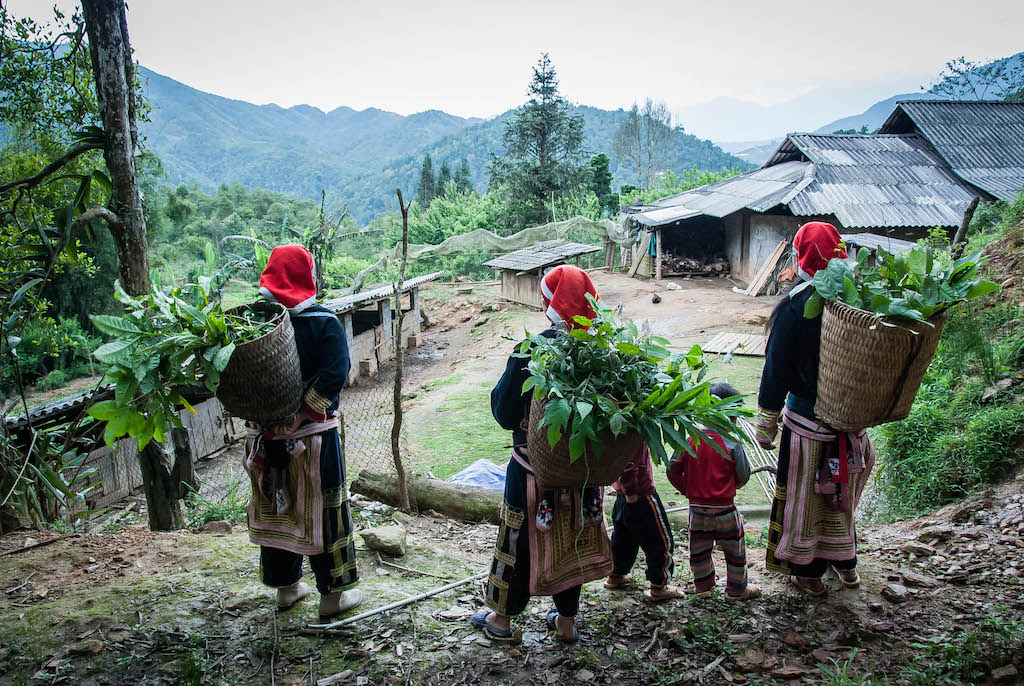
 One of these most northerly tribes are the Red Dao (phonetically zow) – after a long hard day’s work planting rice on terraces or trekking steep mountain slopes, you come home to a hot, steaming herbal bath. My old friend Chi May used to take me out to gather over 70 different plants, shrubs, and herbs—mysterious and some seemingly known only to her. All were collected in backpacks, brought back to camp, crushed in an old guillotine, lowered into huge boiling vats, and left to brew for some time.

Hot Baths with Hill Tribes
Then, stripping naked in the cold mountain night air (yes, it drops below zero in the far north), you immerse yourself into this dark brown, boiling hot, slightly viscous herbal brew in a wooden barrel bath and soak yourself in what felt like a vat of Jägermeister – maybe not as sticky nor alcoholic – but the colour and smell, as delicious.
With the sparkling stars viewed through the hut window, the jangle of a passing buffaloes’ bell and the constant sound of the mountain stream, it’s close to heaven.
That was a speedy ramble on some of the plant influences these years, I’ve written plenty about them elsewhere, and in detail.
Here are plenty of links to my writing, reading, photography and music from in and around Vietnam:
https://www.patreon.com/c/GloriousRant
https://substack.com/@thegloriousrant888
https://500px.com/p/grantjriley?view=photos
https://theecologist.org/2018/nov/30/walnut-trees-sin-ho
Grant J. Riley Bio:
Grant J. Riley is a well-traveled writer who currently lives rurally in the Red River Delta, northern Vietnam. Riley grapples with pressing contemporary issues including climate change, biodiversity decline, and artificial intelligence.
He has published five books including A Journal from the End of Times, Marginal, Handroid, Calling Crows, and Lockdown Hanoi. His work has also appeared in publications including The Ecologist, The Holistic Science Journal, VNExpress International, the Vietnam Economic Times, and Chào Hanoi.
His work focuses on the intersection of technology, ecology, and cultural memory. Having lived and worked in Southeast Asia for over a decade, Riley has developed a particular interest in traditional medicine, sustainable practices, and how local knowledge interacts with modern science. His current research examines how applied science and herbal traditions can coexist rather than compete, and how storytelling can help bridge that divide.
Feel free to contact: grantjriley@gmail.com


Good to read your musings always G. Love the thought of lots of steaming in hot barrels of herbage after a hard days graft, will have to try that when I get back there again.
They’re the best!